Periodontal Disease in Cats: Signs, Stages and Treatment
By Dr Joe Inglis BVSc MRCVS ·
Periodontal disease is an infection of the gums and the structures that hold a cat's teeth in place. It is the most commonly diagnosed health problem in UK cats, and it is often painful, even though cats are experts at hiding it. Caught early, it can be reversed. Left untreated, it causes permanent bone loss, infection and tooth loss. This guide explains how periodontal disease develops, how to recognise it, its four stages, and how it is treated.
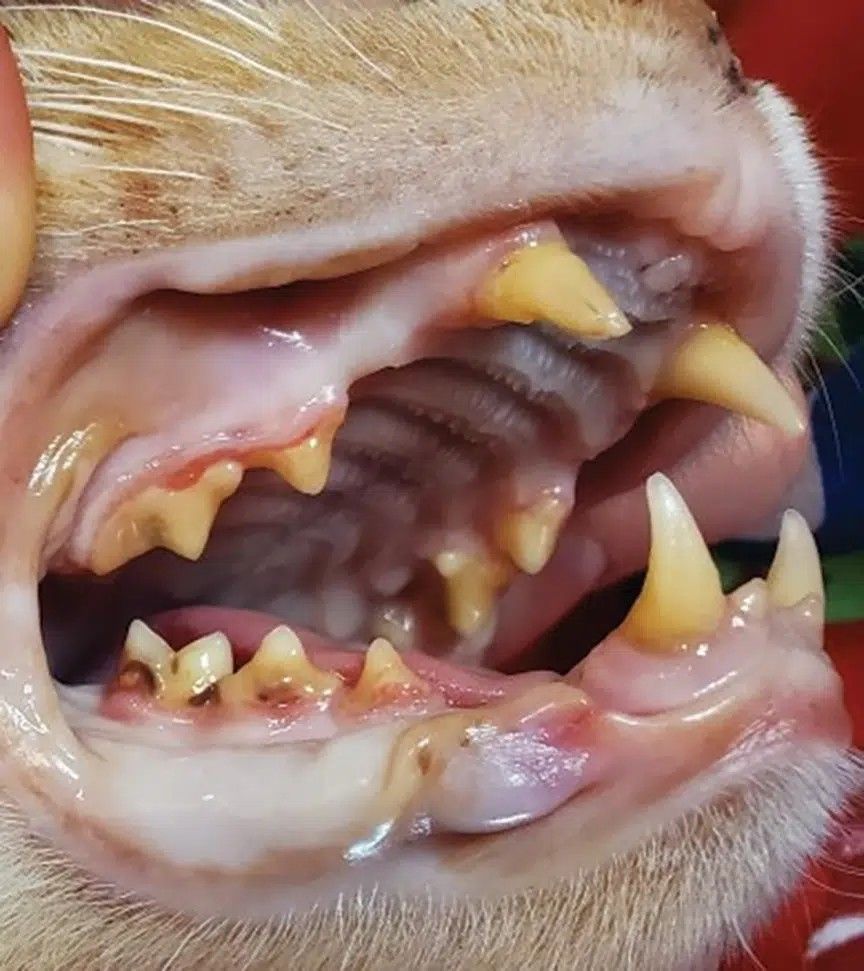
What is periodontal disease in cats?
Periodontal disease is inflammation and infection of the periodontium, the group of tissues that support each tooth. These are:
- The gums (gingiva), which seal around the neck of the tooth
- The periodontal ligament, which attaches the tooth root to the jaw
- The cementum, a thin layer covering the root
- The alveolar bone, the part of the jaw that holds the tooth socket
The disease has two phases. Gingivitis is inflammation of the gums only, and it is reversible. Periodontitis is when the infection has spread deeper, destroying the ligament and bone. This damage is permanent.
The word "periodontal" simply means "around the tooth". It's a useful reminder that this disease mainly affects the tissues around and below the tooth, rather than the visible crown. Cats' teeth and jaws are small, so even a little bone loss can have a big effect on a tooth's support.
How common is periodontal disease in cats?
Periodontal disease is the most commonly diagnosed disorder in UK cats. The UK's largest feline dental disease study, by the Royal Veterinary College (RVC) VetCompass programme, looked at the records of 18,249 cats and found that 15.2% were diagnosed with periodontal disease in a single year. That equates to an estimated 1.8 million UK cats each year (RVC VetCompass).
The true number is very likely higher. Cats hide pain well, and most periodontal disease is below the gumline, where it can only be fully assessed under anaesthetic with dental X-rays. Many affected cats are never diagnosed.
What causes periodontal disease?
Periodontal disease is caused by bacteria in plaque, and by the cat's response to them. It develops in a predictable sequence:
- Plaque forms. Within hours of eating, a sticky film of bacteria called plaque coats the teeth.
- Plaque hardens into tartar. If not removed, plaque mineralises into tartar (calculus) within a few days. Tartar's rough surface attracts even more plaque.
- The gums become inflamed. Bacteria along the gumline cause gingivitis: red, swollen gums that may bleed.
- Bacteria move below the gumline. Plaque spreads into the gap between tooth and gum, where it can't be reached by chewing or brushing.
- The supporting tissues break down. The cat's immune response to the bacteria, together with bacterial toxins, destroys the periodontal ligament and bone. Pockets form, or the gums recede, and the tooth gradually loses its support.
Tartar itself is not the main problem; it is a sign that plaque has been allowed to build up. The real damage is done by bacteria below the gumline, which is why a cat can have serious disease even if their teeth look fairly clean.
Which cats are most at risk?
Any cat can develop periodontal disease, but the RVC VetCompass study found that age and breed were the biggest risk factors (RVC VetCompass).
- Older cats. Cats aged 9 to 12 were 6.7 times as likely to be diagnosed as cats under 3.
- Certain breeds. Some breeds were diagnosed more often than others:
| Breed | Cats diagnosed in one year |
|---|---|
| Siamese | 18.7% |
| Maine Coon | 16.7% |
| British Shorthair | 15.5% |
| Crossbreed | 15.4% |
Other factors that increase risk include crowded or misaligned teeth (for example in flat-faced breeds such as Persians), retained baby teeth, and a lack of home dental care. Conditions that affect the immune system, such as feline immunodeficiency virus (FIV) or feline leukaemia virus (FeLV), may also make gum disease more likely. If your cat is older or a higher-risk breed, regular dental checks are especially worthwhile.
Signs of periodontal disease in cats
Cats rarely show obvious pain from periodontal disease, and most keep eating. Owners often put the signs down to old age. Look out for:
- Bad breath that persists between meals
- A red line along the gumline, the first visible sign of gingivitis
- Tartar build-up, yellow or brown deposits, especially on the upper back teeth
- Receding gums, making teeth look longer or exposing roots
- Loose or missing teeth
- Drooling, sometimes stained with blood
- Dropping food, chewing on one side, or swallowing biscuits whole
- Pawing at the mouth or jaw chattering
- Grooming less, leading to a scruffy or greasy coat
- Hiding, irritability or not wanting their face touched
- Weight loss, as eating becomes uncomfortable
- Facial swelling, which can mean a tooth root abscess
The absence of these signs doesn't mean your cat's mouth is healthy. Early and even moderate periodontitis is often invisible without a full examination under anaesthetic.
The stages of periodontal disease
Vets grade periodontal disease from PD0 to PD4, based on how much of a tooth's supporting tissue has been lost. Each tooth is staged individually, so one cat can have healthy teeth alongside badly affected ones. Staging requires probing and dental X-rays under anaesthetic.
| Stage | Name | What's happening | Typical treatment |
|---|---|---|---|
| PD0 | Healthy | No gum inflammation or loss of attachment | Home care and regular checks |
| PD1 | Gingivitis | Gums inflamed, but no loss of supporting tissue | Professional scale and polish, then home care; fully reversible |
| PD2 | Early periodontitis | Up to 25% of support lost; early pockets or gum recession | Thorough cleaning above and below the gumline; damage is permanent but can be halted |
| PD3 | Moderate periodontitis | 25 to 50% of support lost | Deep cleaning, or extraction |
| PD4 | Advanced periodontitis | More than 50% of support lost; teeth often loose | Extraction is usually needed |
Two things matter most for owners. First, only stage 1 is fully reversible. Second, the stage you can see from the outside often underestimates what's happening below the gumline.
Periodontal disease, tooth resorption and stomatitis
Cats are prone to two other painful dental conditions that often occur alongside periodontal disease.
Tooth resorption is very common in cats, where the body's own cells break down the structure of a tooth. It is a different condition from periodontal disease, but the two are often found in the same mouth. Resorptive lesions frequently start at or below the gumline and are only visible on dental X-rays, which is one reason a full assessment under anaesthetic matters so much in cats. Read more about dental disease in cats
Stomatitis (feline chronic gingivostomatitis) is a severe, painful inflammation of the gums and lining of the mouth. It is thought to be an overreaction of the immune system to plaque bacteria, so it is closely linked to the same bacteria that cause periodontal disease. Treatment usually involves extracting most or all of the teeth.
Because these conditions overlap, a cat diagnosed with periodontal disease should always have every tooth X-rayed and checked for resorption.
Can periodontal disease affect the rest of the body?
Yes. Periodontal disease is not just a mouth problem.
Effects in and around the mouth
- Chronic pain, which cats often hide
- Tooth root abscesses, causing facial swelling
- Loose and lost teeth
- Reduced eating and weight loss, as chewing becomes uncomfortable
- Poor grooming, as a sore mouth makes grooming unpleasant
Effects on the wider body: Infected, inflamed gums allow bacteria and inflammatory substances into the bloodstream. The RVC VetCompass study found that cats with periodontal disease had 1.8 times the risk of having other health conditions, and were more likely to have 21 of the 40 most common disorders in cats (RVC VetCompass). This shows a link rather than proving that gum disease causes these conditions, but reducing a long-term source of infection and inflammation is good for your cat's overall health.
How is periodontal disease diagnosed?
A vet can often spot gingivitis and tartar during a conscious check, although many cats won't allow a long look inside their mouth. To diagnose and stage periodontitis properly, three things are needed, all done under general anaesthetic:
- Periodontal probing. A thin, blunt probe with millimetre markings is gently placed between each tooth and the gum. In a healthy cat it goes in less than 1 mm. Deeper pockets, gum recession, bleeding, and loss of bone between roots all show disease. The probe is also used to check for resorptive lesions.
- Full-mouth dental X-rays. X-rays show the bone around each root, which can't be seen any other way. They reveal how much bone has been lost, whether there is infection at the root tip, whether a tooth can be saved, and whether tooth resorption is present.
- Dental charting. Every finding, tooth by tooth, is recorded on a dental chart. This gives an accurate picture of your cat's mouth, guides treatment, and provides a baseline for future checks.
A conscious examination can only show the visible part of the problem. It's very common to find more disease under anaesthetic than was visible beforehand.
How is periodontal disease treated?
Treatment is always carried out under general anaesthetic, with pain relief, and depends on the stage of disease in each tooth.
For all stages, treatment includes
- Scaling above the gumline to remove plaque and tartar from the visible tooth
- Cleaning below the gumline (subgingival scaling), the most important step, as this is where disease does its damage
- Polishing to smooth the tooth surface and slow plaque build-up
For moderate disease, treatment may also include
- Root planing, smoothing the root surface inside periodontal pockets so the gum can re-attach
- Local antimicrobial gels placed into cleaned pockets, in suitable cases
For advanced disease
- Extraction of teeth that are too damaged to save. Cats' teeth are small and their roots are fine, so extraction is often the most reliable way to remove pain and infection. Cats cope remarkably well afterwards, and most eat normally, including dry food, even after losing several teeth.
After treatment, home care and regular check-ups are essential. Without them, plaque returns within days and the disease will progress again.
A note on anaesthetic-free dentals: cleaning the teeth of an awake cat is not possible to do properly. It can't clean below the gumline, where periodontal disease happens, and can't include X-rays or probing. Veterinary dental specialists advise against it.
Can periodontal disease be reversed?
Only in its earliest stage. Gingivitis (stage 1) can be fully reversed with a professional clean followed by good home care. The gums heal and return to normal.
Once periodontitis has developed (stages 2 to 4), the ligament and bone that have been lost do not grow back. However, treatment can still:
- Stop the disease progressing, saving teeth that would otherwise be lost
- Remove pain and infection, by treating or extracting diseased teeth
- Protect the remaining teeth, through ongoing home care and regular checks
This is why early diagnosis matters so much. The earlier periodontal disease is found, the more teeth can be saved and the simpler treatment is likely to be.
Can periodontal disease be prevented?
Yes, largely. Its cause, plaque, can be controlled. The goal is to reduce plaque every day, before it hardens into tartar.
- Brush daily, if your cat will accept it. Tooth brushing is the most effective way to prevent periodontal disease. Use a soft finger brush or small brush and a toothpaste made for cats, never human toothpaste. Focus on the outer surfaces of the back teeth and the gumline.
- Start early. Kittens who get used to having their mouths handled are much more likely to accept brushing for life.
- Add evidence-based dental products. Dental diets, treats and water additives made for cats can help, especially for cats who won't accept brushing.
- Have regular dental checks. Every 6 months, or more often for older cats and higher-risk breeds.
- Treat early. If your vet recommends a professional clean, acting at the gingivitis stage is the best way to avoid permanent damage.
Many cats won't tolerate brushing, and that's OK. For these cats, dental diets and regular checks are especially important.
How Luna can help
Luna the Dental Vets is a UK veterinary practice group dedicated entirely to dentistry for dogs and cats. Periodontal disease is the condition we treat most often, and our approach focuses on finding it early and treating it thoroughly, while checking every tooth for hidden problems such as tooth resorption.
When your cat visits Luna, you can expect:
- A dental health check to assess your cat's mouth and explain what we can see
- Periodontal probing and full-mouth dental X-rays as standard with every dental procedure
- Detailed charting and staging of every tooth, so you know exactly what was found and why
- Thorough cleaning below the gumline, where periodontal disease does its damage
- Careful anaesthesia and monitoring, with pain relief tailored to your cat
- Clear home-care advice and follow-up checks to keep disease under control
- Bespoke care packages through the Luna Dental Health Club
We have clinics in Bristol, Reading and Eastleigh, with Surbiton opening soon, and we welcome both direct bookings from owners and referrals from your regular vet.